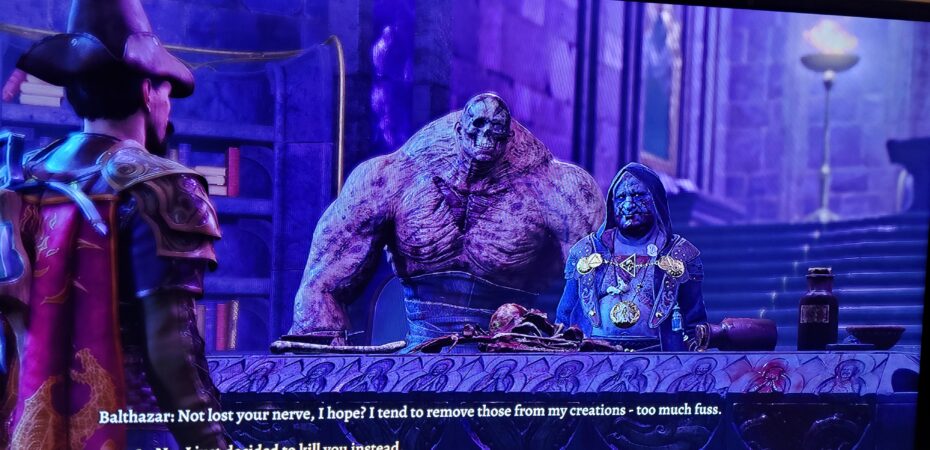
Over the last couple of weeks, many an hour has been spent in Faerûn playing through Baldur’s Gate 3. My party has been through the Underdark and is now roaming through the Shadow Cursed Lands.
Especially the latter place is filled with memorable characters. From a deranged doctor, to a grotesque innkeeper and another grotesque that is transformed, King Midas style, into gold, to an arguably even more grotesque necromancer with his pet golem. The local demon seems plain in comparison. Confronting each of these characters for the first time spelled death for my party. So I tried to do as many of the sparse sidequests as possible and scour the entire map to level up, before I could attempt to confront any of them. This reminded me of Baldur’s Gate I all over again: trudging each map from top-left to bottom-right, removing all specks of fog of war. One aspect of that game that I was not too fond of.
A criticism of Baldur’s Gate 3 so far that there aren’t many things to do. But I’ve read somewhere that that changes in act 3. If that’s the case, then it’s a bit unevenly divided. Up until now I get the feeling that I have to do everything the developers have put in, in order to progress. That takes a bit away from the open world experience. The experience wouldn’t be much different if it was setup more linear. It’s only a minor criticism though, as I’m enjoying exploring, questing and battling very much. And a more focused approach also has it’s merits. And finally, I’m probably missing out on a lot of more hidden stuff. I can’t wait to do another playthrough, although I still have a long way to go, and I’ll probably feel different when I’m closer to the end.
Another criticism I have has more to do with the d&d rules than with this game in particular. I’m not fond of the way you have to prepare spells in advance. It makes it difficult to take the right approach to every battle. Only when you enter combat you know which tactics work, but you are not prepared for this specific situation, so you get slaughtered. Then you know which tactics are required, so you prepare for that, and then the fight is won. I would rather have the chance to adapt on the fly. In that sense I enjoy a system like in Divinity: Original Sin more. And because you can only cast a limited amount of spells from each tier per short rest, it’s ensured that you cannot keep on spamming your most powerful spells anyway. But I do appreciate that in this game not every fight ends up a fiery ocean in which you cannot find your characters anymore, like in D:OS.
Back to the memorable characters and the opportunity they provide for memorable fights. There have been quite a few memorable fights in the many years that I’ve been playing games:
I reckon my most remembered video games fights are the one with the evil knight in Ultima Underworld, or my first encounter with a living tree in that game. That sure gave me the creeps! Or the fight through the tunnels in Might and Magic VI, or one with liches in Might and Magic IX when you try to become one yourself.
In Divinity: Original Sin 2, the first big fight with the crime boss/village leader is a fight I remember vividly. Also the one where you can try to free a prisoner from a scaffold which then gets surrounded by hostiles and you have to fend them off (again a fiery ocean, in which the wooden scaffold miraculously keeps standing tall.)
But one of my most memorable fights must be the fight with a group of golems in Dragon Age: Origins. My party was down to only one character and he or she was almost out of health, but still quick enough to just outrun the slower golems. There were a few of them left and I just kept running around in circles in the confined space and had just a second to turn around and fire at them at each corner. In my mind that continued for half an hour until I was victorious. That was glorious!
My last fight in Baldur’s Gate 3 might have been on the same level. It was with the necromancer in act 2. The whole lead up was entertaining. First you have to decide if you go along with your Skar disciple companion or not. Do you consent in letting her kill a Selûne follower or not. I decided to let her have her fun. But that didn’t feel good when push came to shove. That decision became irrelevant though when the necromancer explained his intentions and I tried to stop him. That proved a bit disastrous, because he summoned a lot of cronies to help him. My fourth companion, Astarion, hadn’t made the jump to the lower platform yet. Eventually he alone survived. In each turn he killed another opponent and took a swill of potion. That way he killed almost six of them. The necromancer was scared, or stupid, or calculating, and remained at a distance. At the end, Astarion ran out of potions and was killed by the last remaining baddy. He would have been killed by the necromancer anyway, but I like to think that there might have been a small chance that he would have made it.
If only I had fully rested beforehand and had access to spells like turn undead or hunger of Hadar. That experience again proves that I’m not a fan of the mechanism of preparing spells. I have to turn to camp after each major battle. It might be realistic, but I’m not here to be realistic, I’m here to have fun! The next time I think I let the necromancer proceed.
One thing I’m not big on is the whole romancing aspect of games like these. I know other people like this, but I don’t care for it. I’ve not made any advances on my companions. It’s fun that I get flack for that from the bone man. He could not help but remark that I was a loner and had no interest in pursuing love. I’ll probably try to romance one character. Just to see what all the fuss is about. I lean towards the Skar disciple at the moment. Maybe that’s why I let her have her way with the Selûne follower. So maybe it is an aspect of the game that is interesting after all.